
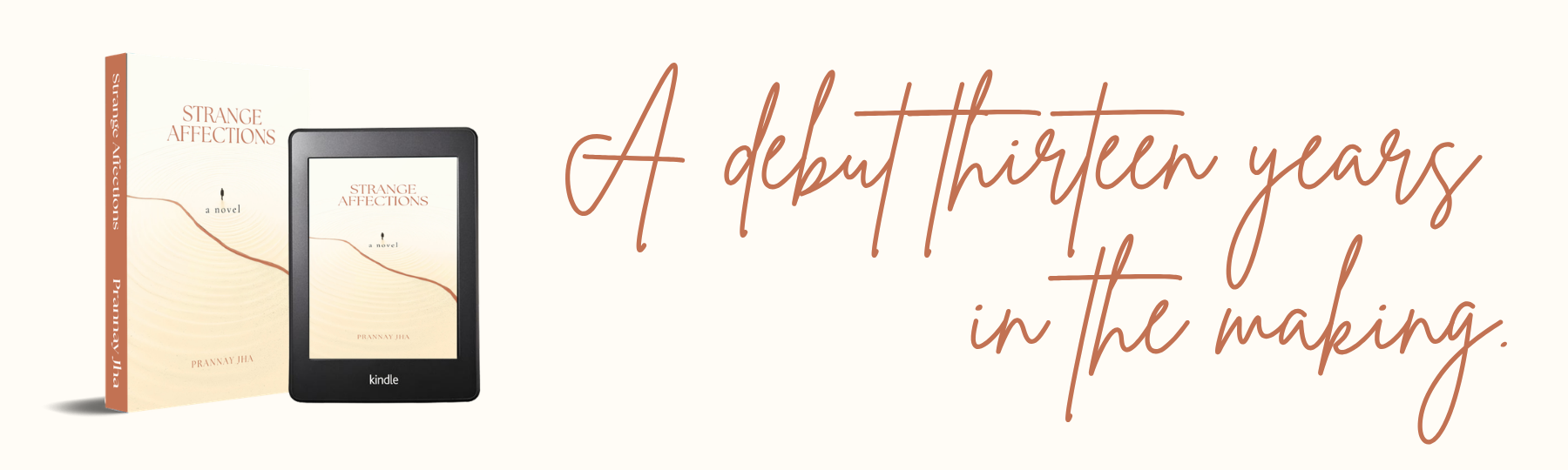
I spent thirteen years writing a novel before I ever thought seriously about self-publishing. That is not a typo. Thirteen years, on and off, around a marketing career, a move from India to Dubai, and every excuse a first novel gives you to keep quietly rewriting it instead of finishing it.
This is not a guide written from the outside looking in. It is the actual path I took with my debut, Strange Affections, a five-voice literary novel set across Italy, France, and Germany. If you are weighing traditional publishing against self-publishing right now, I want to tell you honestly what that decision looked like from the inside, not the tidy version.
Table of Contents
The Traditional Route, and Where It Actually Ended
I did not start out planning to self-publish. Like most first-time novelists, I wanted the imprint, the editor, the validation of someone else choosing my book. I went through Penguin Random House India. The manuscript was read in full by an agent, then passed along internally, and eventually reached the desk of PRH’s Executive Editor and Foreign Rights Lead.
It came back with real, useful feedback, and a pass. The note was something close to: an intriguing concept, written well, but it did not align with their current list. That sentence sat with me for a while. It confirmed something I had suspected for years: this book was never going to be an easy commercial fit, no matter how many times I rewrote it. It was built to be exactly what it is, and that is not always what a list needs in a given season. Indian publishers want Indian stories and mine had nothing to do with India… no characters… no settings whatsoever. Moreover literary fiction by a debut author, spooks publishers.
That pass is the actual starting point of my self-publishing journey. Not a rejection of publishing itself, but a rejection of waiting for permission to put a finished book into the world.
Self-Publishing Wasn’t a Consolation Prize
I want to be direct about something. A lot of writing advice treats self-publishing as the fallback option, the thing you settle for after the “real” path closes. I didn’t experience it that way, and I don’t think you have to either.
Once I decided to self-publish, I got to keep every structural decision I had fought for in the manuscript. The five narrators. The punctuation rules tied to each voice, em dashes only for one character, ellipses only for another, no colons anywhere in the book. A traditional edit might have sanded some of that down in the name of accessibility. Self-publishing meant the book stays exactly as intentional as I built it to be.
That trade-off is worth sitting with before you start. You give up an advance, a marketing budget, and a certain kind of institutional credibility. You keep the book. And you make about three times per book sold! You see as a debut author, you get paid maybe 7.5% for each book sold. If you choose say an amazon KDP, the math works around 25% depending on your pricing, pages, etc.
Building the Actual Infrastructure
Here is the part nobody tells you about self-publishing: most of the work is not writing. It is infrastructure.
I founded my own imprint, Subtlewords Press, under my existing company, so the book would have a real publisher name on it rather than just my own. I registered an ISBN. I set up Kindle Direct Publishing for both the ebook and the paperback, and a separate seller account for India fulfilment through FBA, because Amazon’s systems do not treat every territory the same way.
Formatting took longer than I expected. A 5×8 inch trim, Garamond at 11.5pt, mirrored margins, matte cream paper, run through Kindle Create for the table of contents. None of this is difficult individually. All of it takes time, and every step is a place where a rushed self-publisher ends up with a book that reads as unfinished, even when the writing itself is strong.
For the print run, I went through a dedicated printer rather than print-on-demand alone, because I wanted stock in hand for bookstore consignment, award submissions, and gifting, not just what Amazon could fulfil on demand.
The Marketing Lesson I Had to Unlearn
I run a marketing agency. I assumed, wrongly, that this would make marketing my own novel the easy part. It didn’t.
Literary fiction does not sell the way most products sell. Paid ads are a conversion tool here, not a discovery engine. I ran the numbers on trying to hit a meaningful sales target purely through advertising spend, and the acquisition cost was several times higher than what the book could ever earn back per copy. That is simply the economics of this genre, and no amount of campaign optimisation changes it.
What actually moves a self-published literary novel, in order, is one strong review in a trusted outlet, a prize longlist, word of mouth from a genuinely small number of the right readers, and your own existing platform. I had spent years building an audience through a finance and lifestyle channel that had nothing to do with fiction. That audience would turned out to matter more to this launch than any ad account I could build from zero.
If you are approaching self-publishing and you don’t have an existing audience yet, start building one months before you need it, around your actual voice, not around the book you are about to release.
Reviews Are the Real Currency
I underestimated this before I started. On Amazon and Goodreads both, review count and rating average are not vanity numbers, they are the mechanism that decides whether anyone outside your existing circle ever sees the book at all. A handful of early ARC readers, seeded carefully and given real time to actually finish the book, matters more than a launch-week ad spend. I am currently working on a list of people I’d bother for reviews. Another list of about 1000 people that I’d bother to buy.
Goodreads and Amazon do different jobs. Goodreads is where literary readers discover a book before they’ve decided to buy it. Amazon is where an already-interested reader confirms the purchase. Treat them as two separate stages of the same campaign, not one interchangeable review pool.
What I’d Tell Someone Starting This Today
If you are considering self-publishing your own novel, here is what I wish someone had told me plainly before I started.
Finish the manuscript completely before you think about any of this. Infrastructure is only worth building around a book you actually stand behind. Expect the traditional route, if you try it, to teach you something useful even in rejection, mine did. Budget real time for formatting and production, not just writing. Build your reader relationships before launch week, not during it. And accept early that literary fiction, in particular, is a long game measured in reviews and word of mouth, not a single strong ad week.
Self-publishing gave me back control of a book I had spent thirteen years protecting. It also handed me a second job I hadn’t fully signed up for. I’d still choose it again.
Strange Affections releases October 1, 2026 under Subtlewords Press.