
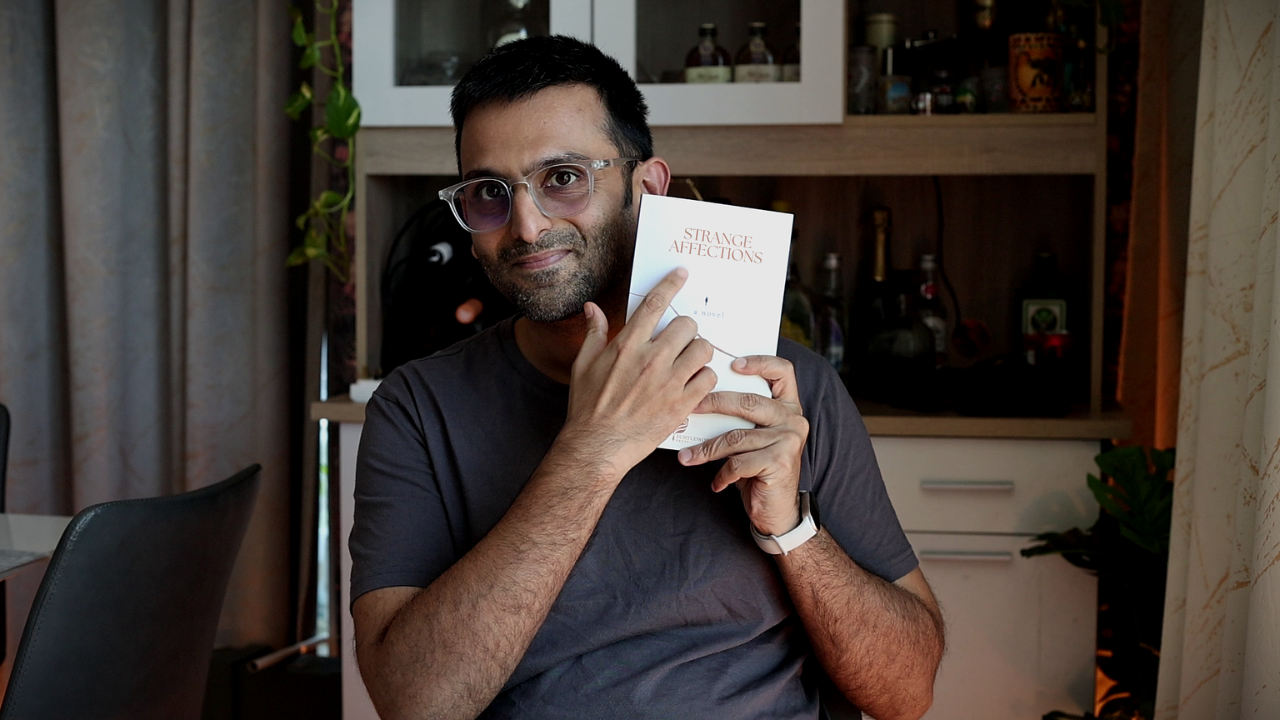
My debut novel went on sale in India this month. No publisher, no distributor, no advance. Self-publishing a novel in India cost me 1,000 printed copies, a ₹91,000 print bill, and one mistake that almost stopped the entire shipment at the warehouse door.
Here is my position, and the rest of this piece defends it. The hard part is not the writing or the printing. It is the supply chain and the paperwork, and almost every guide online skips both because the people writing them only ever uploaded an ebook.
I spent 13 years on this manuscript and about four months on the launch. The four months taught me more that was practically useful. These are the seven things that cost me money, weeks, or both.
Table of Contents
What self-publishing a novel in India actually cost me
These are my real numbers for a 202 page paperback, 5×8 inches, matte cover, cream paper, printed by Manipal Technologies and shipped to Gurgaon.
| Line item | What I paid |
|---|---|
| Printing, 1,000 copies at ₹86 a copy | ₹86,000 |
| Freight to Gurgaon at ₹5 a copy | ₹5,000 |
| Cover design, done myself in Canva | ₹0 |
| ISBN through isbn.gov.in | ₹0 |
| Amazon KDP ebook and paperback setup | ₹0 |
| MRP stickers, unplanned | ₹1,000 |
Landed cost per copy is ₹92, roughly AED 4.50. Total outlay for self-publishing a novel in India came to ₹92,000, which is less than most people assume and far less than a vanity press will quote you for the same job.
The ISBN line is the one to notice. India gives them free through the government portal, so pay nobody for one. The cover line is zero for the same reason. I designed it myself in Canva rather than briefing a designer, and no reader has yet asked who did it.
Mistake 1, printing 1,000 copies with no MRP on them
The cartons reached Gurgaon and the back covers carried a barcode and no printed MRP. In India that is a problem at the retail end. Amazon India expects a maximum retail price on the pack, and physical retail prices everything off the MRP.
The fix was a 1×2 inch sticker over the ISBN barcode on all 1,000 copies, carrying MRP ₹399 and a merchant printed FNSKU, applied by hand before the FBA inbound. That is ₹1,000 of stickers and a full day of labour that did not need to exist.
The PO had the MRP. The cover artwork did not. A printer builds from the artwork file, not from the purchase order. This is the unglamorous half of self-publishing a novel in India, and no guide covers it.
[IMAGE, back cover with the MRP and FNSKU sticker over the barcode. Alt text, self-publishing a novel in India with an MRP sticker applied over the ISBN barcode]
Action, put MRP, ISBN and barcode in the cover artwork spec, and ask the printer to email you a photograph of one finished copy before they bind the rest.
Mistake 2, assuming KDP covers India
Amazon KDP handles the ebook everywhere and prints paperbacks in the US and UK. It does not print in India. An Indian reader ordering the KDP paperback gets an import with a long delivery window and a price no one in Delhi will pay for an unknown author.
So self-publishing a novel in India means running a second supply chain in parallel. Mine looks like this.
- Local print run with an Indian printer, in my case Manipal Technologies
- My own Seller Central account rather than a distributor
- GST additional place of business approval for each fulfilment centre, DEL4, DEL5 and DED4
- Merchant printed FNSKU labels on every copy
- FBA inbound so the listing carries Prime delivery
The GST registrations are the slow part and nobody warns you. Start them before the books are printed, not after.
Action, open Seller Central and file the APOB applications the week you place the print order.
Mistake 3, formatting from the wrong file
I almost sent the printer a file that was three drafts old. The formatted interior had been built early, the text kept improving in a different document, and the two quietly drifted apart.
The old file still contained lines I had already corrected, including a dozen Indianisms that had no business in a novel set in northern Italy and the Black Forest. Words like staying with, music system, and email ID read as home to me and as a tell to an editor in London.
I caught it with a plain text diff two weeks before content lock. Had I not, 1,000 copies would have carried the errors permanently, because a printed book has no update button. Self-publishing a novel in India makes you your own production manager, and production managers check files.
Action, name one canonical manuscript file, pour the interior from that file only, and run a diff between the formatted interior and the manuscript before you approve the proof.
Mistake 4, pricing before I understood the fees
I set the India paperback at MRP ₹399 and a launch selling price of ₹299, about AED 13. The ebook is ₹199 in India and $3.99 in the US, enrolled in KDP Select.
The live listings, if you want to see how that looks in practice, are the paperback at ₹299 and the Kindle edition at ₹199 in India, the US paperback and US Kindle, the UK paperback and UK Kindle, and the Canada paperback and Canada Kindle.
Here is the uncomfortable part. At ₹299, after a ₹91 landed cost, Amazon referral fees, FBA fulfilment and the GST on those fees, the margin on a paperback is small enough that it rounds to nothing.
I priced it that way on purpose, because my target is copies in hands, not profit. The pricing maths of self-publishing a novel in India only works once you know which of those two you are chasing. If your target is income, run the fee calculator in Seller Central before you commit to an MRP, not after the cover is printed with that MRP on it.
Action, decide in one sentence whether this book is a business or a calling card, then price for that and stop second guessing it.
Mistake 5, expecting Amazon ads to find readers
I went in believing ad spend would create discovery. For literary fiction it does not. Amazon ads convert a reader who is already close to buying. They do not introduce an unknown literary novel to anyone.
What has actually worked in the first month.
- Auto campaigns on day one, left alone for a full week, then the converting search terms harvested into manual campaigns.
- Product targeting against specific comparable titles, which is the most precise lever available and can run from the first day.
- Mid tier literary names as interest fields rather than the giants. Readers who follow Rachel Cusk or Jenny Offill behave like buyers. Readers who follow a canonical name behave like students.
Genre fiction runs on ads. Literary fiction runs on reviews, bookshops, prize lists and word of mouth over 12 to 24 months, and no budget shortens that. It is the slowest truth about self-publishing a novel in India.
Action, put your first ₹10,000 into comparable title targeting, not keywords.
Mistake 6, giving copies away instead of selling them
My first plan put 500 of the 1,000 copies into free channels. Bookshop consignment, prize submissions, influencer mailers, book clubs, libraries, rights scouts, gifted copies.
Then I did the arithmetic. A gifted copy produces a review with no Verified Purchase badge, which carries less weight on the listing than a review from someone who paid ₹299. A paid sale moves the rank, feeds the also bought engine, and earns the review badge at the same time.
Qualified gifting also does not scale. Checking that a stranger actually reads literary fiction before handing them a copy caps the method at around 65 copies, because each one is a conversation. Self-publishing a novel in India at any real scale means choosing channels that do not need you in the room.
I still give books away, but the free copies now chase things a sale cannot buy, which is a prize entry, a bookshop table, or a translation scout in Paris.
Action, write down what each free copy is supposed to return before it leaves the carton.
Mistake 7, waiting 13 years for a publisher to say yes
The book started as a 2,000 word draft in 2013 and a 5,000 word short story in 2016. It went through a former Penguin Random House India editor, then an agent, then two editors inside the house, each reading a full manuscript.
The final answer was that the concept was intriguing and the writing strong, but it did not fit the current list. That is a real answer and a fair one. It also took years to arrive.
Here is what I would tell my younger self. Submit widely and prepare for self-publishing a novel in India at the same time. The ISBN, the imprint, the Seller Central account and the website cost almost nothing and take weeks, not years. If a publisher says yes, you have lost nothing. If they do not, you launch the same quarter instead of the next decade.
Action, register your imprint and your free ISBN this month, whatever stage your submissions are at.
Mistake 8, forgetting that Amazon defaults to 18% GST
Printed books are nil-rated in India under HSN 4901. I knew that, set the HSN correctly, and then forgot that the tax actually charged on an Amazon India listing comes from the Product Tax Code on the offer, not the HSN. Mine was left at the default standard-rate code, so Amazon generated invoices with 18% IGST carved out of my ₹299 rather than added to it. ₹253.39 to me, ₹45.61 of tax, on a supply that is exempt.
Action: open Seller Central, Edit listing, Offer tab, and set the Product Tax Code to the book-exempt code before your first sale, not after.
What to do this week
If you are self-publishing a novel in India in the next six months, do these five things in this order. Each one takes an evening.
- Apply for your free ISBN on the government portal at isbn.gov.in and register your imprint name.
- Open Seller Central and start the GST additional place of business applications, because they will finish last.
- Get a print quote for 1,000 copies from an Indian printer and ask what is included in freight. My benchmark is ₹86 a copy plus ₹5 freight for a 202 page paperback.
- Write MRP, ISBN and barcode into the cover artwork brief, then ask for a photograph of a finished copy before the full run is bound.
- Pick one canonical manuscript file and delete every other copy from your desktop.
- Ensure you have the right exempted Product Tax Code on Amazon
I am one month into this launch, not one year, so treat all of it as a field report rather than a finished theory. I will publish the sales numbers at the 90 day mark, including the ones that look bad.
Also Read: Strange Affections Book Launches in India, 7 Essential Things Hidden in My Debut Novel