
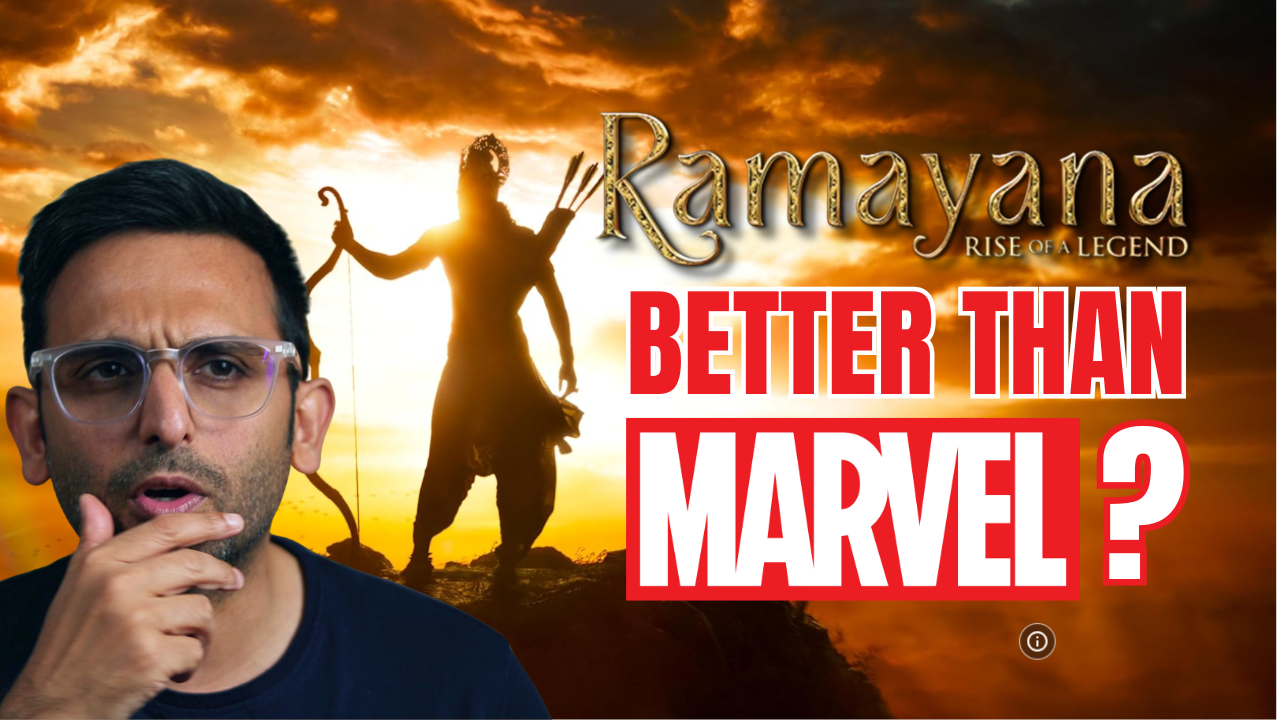
I watched Ramayana Part 1 on opening day and walked out of the theatre thinking one thing: this is the closest Bollywood has ever come to a Hollywood-level action movie. That’s my ramayana movie review in one line. But the details matter, so let me break it down.
Nitesh Tiwari didn’t make a devotional retelling. He made a $200 million action epic with DNEG-level VFX, a Hans Zimmer and A.R. Rahman score, and a storytelling choice that makes the entire first part about the villain, not the hero. Whether you agree with that choice or not, it works.
Here’s why. My detailed Ramayana Movie Review:
Table of Contents
Ramayana Movie Review: The Storytelling Choice That Changes Everything
As kids, we all heard the same version: Ram is pure, Ravana is evil, Sita gets kidnapped, good wins. That version has always felt flat from a narrative standpoint. Not because the story is weak, but because the characters are too clean. There’s no friction, no moral ambiguity, and therefore not a lot of relatability for a modern audience.
I say this as a writer — I recently published my debut novel Strange Affections — and the first thing I look for in any story is whether the characters have enough texture to hold my attention.
Nitesh Tiwari solved this problem by doing something bold: he made Part 1 about Ravana.
You see Ravana’s backstory, his rise to power, and his motivations. This isn’t just filler. It’s the foundation of a good story. A hero is only as compelling as the villain standing across from him, and Tiwari understood that. The movie spends serious screen time building Ravana into a character you almost understand.
That’s storytelling. And it’s why this ramayana movie review starts with the villain, not the hero.
Yash as Ravana: The Performance That Steals the Film
Yash was terrifyingly believable as Ravana. When his entry sequence hits — the music, the dance, the sheer aura — I had goosebumps in the theatre. This wasn’t a cartoon villain. This was a fully realized character with weight and presence.
For context, in Ramayana, Ravana is an Asura (the closest equivalent to a devil figure in Hindu mythology), but the movie doesn’t reduce him to that label. He’s shown as someone who earned his power, and that backstory is shot like a standalone action film.
The entire first act belongs to Yash. And he delivers.
Action Sequences: Marvel, Mad Max, and Bollywood’s Best
The action in this film is genuinely at the level of Hollywood tentpoles. I’m not exaggerating. There are sequences that felt like I was watching Mad Max: Fury Road — the intensity, the pacing, the choreography.
This makes sense when you consider the team behind it. The VFX was handled by DNEG, the studio behind 18 Oscar-winning films. The budget sits at around $200 million for both parts combined. When you throw that kind of money at a project with this level of talent, the output should be world-class.
And it is. The texture, the compositing, the lighting on characters like Jatayu (the mythological bird) — it all holds up. People online said Jatayu looked “too animated.” That was not my experience at all.
One small gripe: the physics of side characters getting hit still doesn’t look fully believable. Indian films have a long-standing issue with extras falling like they’re in a 90s serial rather than a feature film. It’s a small detail, but it’s the 5-10% gap between Bollywood and Hollywood action that still exists.
Hans Zimmer and A.R. Rahman: A Score That Carries the Film
I actually Googled the music score while sitting in the theatre because I was so impressed. Hans Zimmer (who also scored Mad Max) and A.R. Rahman collaborated on this, and you feel the result in every scene.
I read some opinions online claiming Rahman didn’t deliver. I could not disagree more. The score carries the tension, amplifies the action, and gives the quieter moments their emotional weight. This might be one of the best Hindi film scores I’ve heard.
The Cast: Ranbir, Sai Pallavi, and a Surprising Ravi Dubey
Ranbir Kapoor’s portrayal of Ram is restrained. That’s a deliberate choice, and the right one for this character. Ram in Treta Yuga is meant to be pure — there’s no room for a showy performance. The risk of casting a well-known actor in a mythological role is that the audience sees the actor, not the character. Ranbir largely avoids that trap.
Sai Pallavi as Sita is solid. Her action sequences caught me off guard — she brings genuine physicality to the role.
The surprise package is Ravi Dubey as Lakshman. The movie needed a comic element to balance the intensity, and he delivers that with a natural charm. Side note: am I the only one who got strong Sushant Singh Rajput vibes from his acting and voice?
The One Story Beat That Didn’t Land
If I had to nitpick, it’s Kaikeyi’s character arc. The build-up shows her maidservant Manthara filling her ears across multiple scenes, but in each of those scenes, Kaikeyi pushes back. She says she treats Ram as her own son.
Then, in the final scene, she flips — asks for Ram’s 14-year exile and her son Bharat to be made king. The motivation didn’t feel earned. The events leading up to the flip didn’t build enough pressure to justify a decision that drastic.
This is a screenwriting problem, not an acting one. The flip needed either more scenes of doubt or a single catalyzing event that changed everything. Without that, it reads as a plot requirement rather than a character decision.
VFX and Cinematography: World-Class With One Small Gap
People criticized the heavy use of red and blue color grading. That criticism doesn’t land for me. You don’t say Mad Max was “too orange” or Avatar was “too blue.” Color grading is a deliberate creative choice, and this one creates a distinct visual identity for the film.
The VFX overall is at par with anything from Marvel or DC. DNEG’s pedigree shows in every frame. The only area that needs work in Part 2 is the physics of background characters in fight sequences — as I mentioned, the way extras react to impacts still feels slightly off compared to the best Hollywood action.
But that’s a 5-10% gap. The remaining 90% is world-class.
Final Verdict: Why This Ramayana Movie Review Is a 9/10
Ramayana Part 1 held my attention for over three hours. That alone says something. The combination of Tiwari’s storytelling choices, Yash’s performance, the VFX quality, and the Zimmer-Rahman score makes this the most ambitious Indian film I’ve seen.
I’ll give you a disclaimer: I loved Brahmastra as well (barring the dialogues). Both sequels — Ramayana Part 2 and Brahmastra 2 — are reportedly coming in 2028, and I’m genuinely looking forward to both.
Because what excites me most isn’t this one film. It’s the signal it sends. Bollywood is capable of creating movies at the level of Hollywood when it comes to action and spectacle. And I don’t mind Ramayana being treated as an action movie. It makes the story way more interesting.
Go watch it. Form your own opinion. And tell me in the comments if you agree.
Read All Dubai Related Articles
Read All Travel Related Articles